By Ori Martins
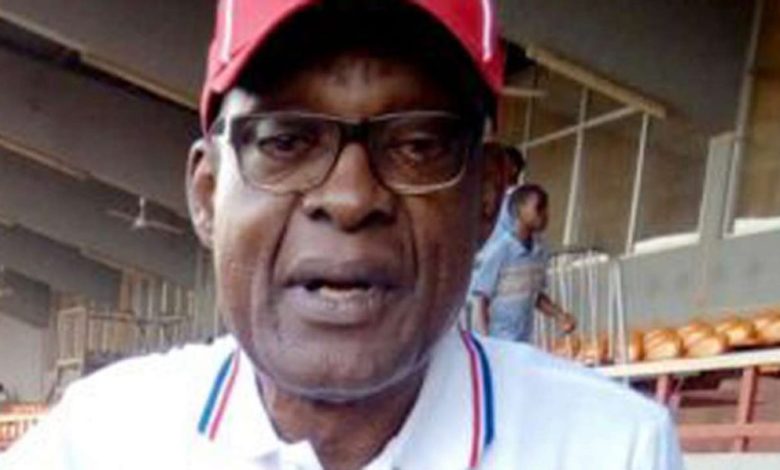
One of Africa’s all time best goalkeepers, Emmanuel Ogujiofor Okala recently turned 75. Two striking tributes taken from two different established materials succintly summoned up Okala’s distinguished goalkeeping career.
“Okala surely proved himself to have the safest pair of hands in Africa. For many years he was the reliable goalkeeper for both the famous Enugu Rangers club and Nigeria’s Eagles. Together with his teammate, centre half Christian Chukwu, he made Nigeria’s defence one of the most calm and discplined in Africa. And many times he saved both club and country from certain defeat” (Page 10).Taken from Football and Great Footballers, a Longman publication, 1981.
And, this, from The Field Marshal, A Biography of Christian Chukwu. “The execution of the Nations Cup campaign by the Eagles’ technical crew was very successful except for an ugly inicident that occured at the final match against Algeria. This had to do with the decision by the Eagles bench to substitute goalkeeper Best Ogedegbe with the former number one goalkeeper Emmanuel Okala a few minutes to the end of the match. While Okala was warming up to be introduced into the match, on the instruction of Coach Otto Gloria, the team manager, Mr Cud Joe Alakija, quickly intervened and instructed that Okala should not be fielded” (Page 157).
Okala was obviously the first Nigerian goalkeeper to receive both national and international attention. His debut was against Tanzania on November 11,1972, Nigeria won 3-2 in that friendly encounter. Okala, the towering goal tender’s last game was another friendly game against Cameroon on February 2, 1980, just few weeks away from the historic African Nations Cup Finals. He had 53 caps.
Remarkably, Okala was one goalkeeper who never lost to Cameroon. With Okala, Cameroon dreaded Nigeria, Egypt feared the Eagles while Morocco, Tunisia and Algeria respected the green, white and green colours of the West Africans. It was after his exit that the Super Eagles started losing to the Indomitable Lions of Cameroon with its seed in the 1984 Nations Cup Finals in Cote d’Ivoire.
At six feet, six inches tall, it is believed that Okala is the tallest player ever to have come out of Nigeria as he is an inch taller than Nwankwo Kanu who was the tallest player in virtually all the competitions he attended, perhaps with few exceptions.
Okala was an integral part of the glorious Rangers era that dominated both Nigerian and African football. Rangers’ turn around was in 1973 when they Coal City Boys lifted the Premier League and retaining it in 1974 and 1976. In addition, Rangers were the Federation Cup champions in 1974 thereby registering their dominace at both the league and federation cup competitions.
In 1975, just five years after the civil war, Rangers, with Okala as goalkeeper, played to the final of the CAF Champions League Finals, dismantling teams from East, South, North and West Africa. They faced Hafia of Guinea in the final having dislodged Mehalla of Egypt in the semi-finals.
The first leg of the 1975 CAF Champions League final game on Saturday, December 8, at the September 8, Stadium, Conakry, Guinea. The Nigerian delegation was led by the Federal Commissioner of Youths and Sports, Brig Gen James Oluyoye. As early as 11am on that particular day, the stadium was already filled to capacity.
There were three dangerous players that tomented Rangers to no end but thanks to Okala who saved the Nigerian representatives from those onslaughts. The players were, hitman Papa Camara, his two wingers, Sory and Janicky who supplied him with those deadly crosses. Eventually, Rangers lost 1-0.
There were hopes that Rangers would cancel the Conakry defeat in Enugu in the return leg tie. They team, guided by a veteran coach, Dan Anyiam, worked fervently for the D – Day. However, the unexpected hapened. The NFF had the venue of the game changed from Enugu to Lagos. All efforts made for Rangers to play the return leg tie against Hafia of Guinea proved abortive.
What was the most painful was that the directive changing the match venue came barely 24 hours to the epuc battle. When it was rumoured that NFF favoured Lagos than Enugu, the East Central State director of sports, Mr Cliford Eneli, wrote to the NFF and urging it to allow the game to be played in Enugu. However, the NFF said its main reason of having the all important last game to be decided in Lagos was because of the comfort of FIFA and CAF officials who were billed for the match.
As it turned out, Rangers hurried to Lagos. On match day, Mathias Obianika scored from the penalty box after Dominic Nwobodo was rudely brought down in the vital area. In the second half, Hafia equalized and a penalty was converted to make it 2-1 against Rangers and an aggregate of 3-1 against the Enugu side. It was the first time a Nigerian team had ever qulified for the final of any CAF organized club competition.
As Rangers missed the Champions League chase, Shooting Stars, in 1976, struck gold in the CAF Cup. And in 1977, Rangers dethroned Shooting Stars in the semi-finals and went ahead to win the title thereby retaining the diadem for the country.
In 1980 when Nigeria lifted the Nations Cup for the first time, there were six Rangers players in that team – the highest by any club: Christian Chukwu, Aloysus Atuegbu, Ifeanyi Onyedika, Adokiye Amiesimaka, Sylvanus Okpala and Emmanuel Okala. Shooting Stars had Best Ogedegbe, Segun Odegbami Muda Lawal and Felix Owolabi. Insurance of Benin players were David Adiele, Kadiri Ikhana.
After Rangers’ 1982 victory, Chukwu and Okala retired and it took Rangers over three decades before they emerged Nigeria’s champions in 2016 and in 2026,another league trophy was won making it the team’s ninth league trophy in its history. Enyimba of Aba, a team founded by the late Chief Jeery Enyeazu who equally established Rangers, also have nine Premier League titles to their credit.
Enyimba, however, became the first and only Nigerian side to have lifted the CAF Champions League, and even did in grand style by winning it back -back.
Another club established by Enyeazu, Heartland (in the beginning, Spartans and later Iwuanyanwu Nationale) equally were in the final of the Champions League in 1988 but lost to Setif of Algeria. In all, Heartland have five league titles to their credit.
Perhaps, the fact that Rangers 2026 league victory came during the birthday anniversary of the legendary goalkeeper Emmanuel Okala is absolutely sensational and remarkable.
All of Rangers, Heartland and Enyimba have at one time or the other proved that the region they are from have what it takes to turn Nigerian football around. Enyeazu who established the three teams was the brains behind the commencemt of National Sports Commission; Jim Nwobodo took Rangers to continental heights, Anyansi Agwu made Enyimba African and Nigerian champions and the trio of Lemmy Akakem, Uche Ejimofor and Fan Ndubuoke made Heartland FC a household name in Nigeria and Africa.
Football administrators from the South East can turn around Nigerian football. This is their erternal resolve – taking football to greater heights. Hence, Commodore Emeka Omeruah as sports minister, brought home the FIFA U – 17 World Cup in 1985; as NFF boss, he qualified Nigeria for the World Cup for the first time in 1994, and gave the country the Nations Cup for the second time; in 1996, Omeruah led Nigeria to Olympic soccer gold, beating Brazil and Argentina.