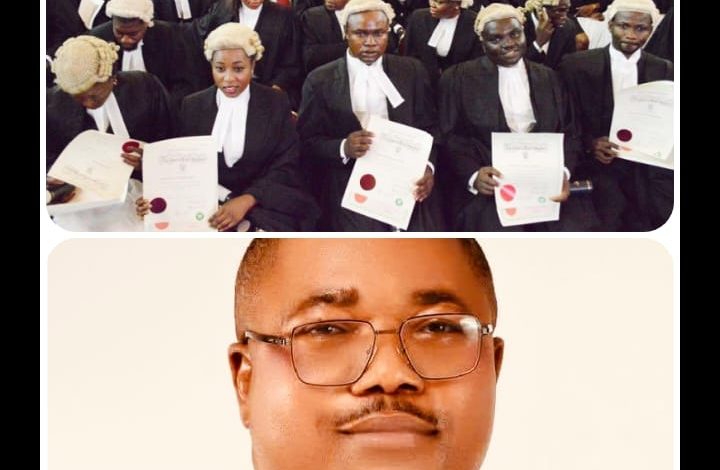
Human rights lawyer and lead counsel to the Indigenous People of Biafra (IPOB), Sir Ifeanyi Ejiofor, has raised alarm over the declining moral, ethical, and professional standards within Nigeria’s legal profession.
Ejiofor, in a statement issued on Wednesday titled “Midweek Musing: When Nobility Ebbs and the Bar Descends A Clarion Call to Rescue the Soul of the Legal Profession in Nigeria,” urged the Nigerian Bar Association, the Body of Benchers, and other relevant institutions to take urgent steps to salvage the noble profession.
Ejiofor, who holds the traditional title of Dunu-Ezeugosinachi, stated that not too long ago, there existed a defining era in Nigeria’s jurisprudential history when the legal profession stood not merely as a vocation, but as a sacred trust an honourable calling anchored in dignity, discipline, and an unwavering commitment to justice.
Regrettably, he said, that era has receded into memory and now remains only a shining benchmark in the annals of Nigeria’s legal heritage.
“It was, indeed, the age of giants an age exemplified by Chief Frederick Rotimi Alade Williams, the first indigenous Senior Advocate of Nigeria, whose forensic brilliance and courtly elegance set enduring standards. It was also the era of Chief Abdul-Ganiyu Oyesola Fawehinmi, whose courage and principled resistance to tyranny elevated the moral authority of the Bar and inspired generations.
“On the Bench, the judiciary was graced by intellectual titans: Justice Chukwudifu Akunne Oputa, revered as the ‘Socrates of the Supreme Court’ for his philosophical depth; Justice Adolphus Godwin Karibi-Whyte, known for the clarity and precision of his judgments; Justice Kayode Eso, a fearless guardian of constitutionalism; and Justice Muhammadu Lawal Uwais, whose tenure exemplified integrity and institutional strength.
“The profession has also been enriched, in its continuing evolution, by distinguished living legends such as Chief Afe Babalola, SAN; Chief Wole Olanipekun, SAN; Chief Olisa Agbakoba, SAN; and Chief Onyechi Ikpeazu, SAN,figures whose contributions have helped sustain the nobility and relevance of the Bar.
“In those halcyon days, the nobility of the legal profession was not symbolic; it was lived. Advocacy was an art, ethics a creed, and the courtroom a temple of justice where decorum, learning, and integrity were non-negotiable,” he said.
According to him, that noble standard now appears to be eroding at an alarming rate.
He noted that admission into the profession,once a rigorous process that tested both intellect and character risks becoming predominantly academic, with insufficient emphasis on moral and ethical grounding.
He said the consequences are both visible and troubling.
Ejiofor observed that a growing number of practitioners demonstrate diminishing familiarity with the refined language and discipline of the courtroom, replacing erudition with crudeness and precision with mediocrity.
“In some instances, courtrooms,once sanctuaries of reason have devolved into arenas of disorder, where conduct unbecoming of the profession occurs with little restraint.
“Even more concerning is the gradual reflection of these deficiencies within the judiciary itself. When individuals insufficiently grounded in the ethos of the Bar ascend to the Bench, the very foundation of justice is placed at risk. Inevitably, this raises a critical question: what quality of justice can emerge from such a system?
“A recent incident further underscores this concern. The exercise of judicial authority in ways that appear arbitrary,such as directing a legal practitioner to kneel in open court ,signals a troubling erosion of institutional decorum. While discipline in the courtroom is essential, it must always align with established legal standards and respect for professional dignity.
“Equally disconcerting is the increasing normalization of sharp practices within the profession. Procedural ambush, ethical compromise, and deliberate obstruction are, in some quarters, being deployed as litigation strategies.
“There are instances where even senior members of the Bar engage in conduct that undermines justice. Such conduct includes the filing of court processes and the deliberate removal to one’s chambers of all service copies intended for opposing counsel months in advance of the adjourned date, only to return to court on the day the matter is scheduled for hearing to effect service in open court,thereby frustrating and truncating the proceedings of the day.
“When objection is raised by opposing counsel, such a practitioner brazenly contends that the said counsel ought to have attended his chambers to collect the processes, and, in such circumstances, he regrettably enjoys the protection of the court. This is a personal experience.
“Such actions, whether isolated or systemic, represent not only professional misconduct but a direct affront to the administration of justice. When such behaviour is tolerated, or worse, shielded by rank, it fosters a dangerous culture where accountability becomes selective, eroding the moral fabric of the profession,” he stated.
According to him, this trend is unsustainable and, if left unchecked, threatens a systemic erosion of public confidence in the legal system,a consequence far more damaging than individual acts of misconduct.
The human rights lawyer stressed that the legitimacy of the law ultimately rests on trust, and once that trust is compromised, the very foundation of civil society is endangered.
The IPOB therefore called on the custodians of the profession to rise to the challenge.
“The Nigerian Bar Association, the Body of Benchers, the Legal Practitioners Disciplinary Committee, and the Council of Legal Education must take decisive steps to restore ethical standards, reinforce discipline, and uphold merit in the training, admission, and regulation of legal practitioners.
“The time has come to move beyond rhetoric to meaningful reform to recalibrate entry standards, enforce discipline without fear or favour, and revive the culture of excellence that once defined the Nigerian Bar.
“If the current decline is allowed to persist, history will render a harsh verdict: that a noble profession, once the conscience of the nation and a bastion of justice, was diminished through complacency and neglect,” he added.
He added that what is required to rescue the legal profession in Nigeria is courage,the courage to confront uncomfortable truths, enforce standards impartially, and insist that the legal profession must not merely exist, but must earn and sustain its revered place in society.