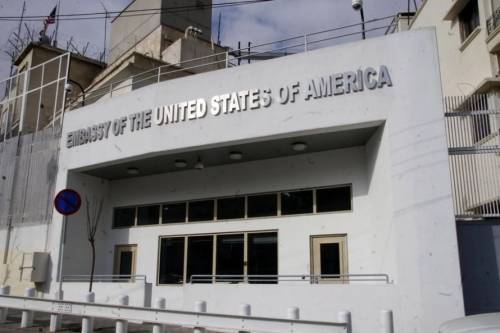
Lawyer to the Indigenous People of Biafra (IPOB), Sir ifeanyi Ejiofor has described the United States’ authorization for non-emergency staff and their families to vacate its embassy in Nigeria as a serious security concern.
Ejiofor, a human rights lawyer also stated that the decision by the United States Government to authorize the departure of non-emergency personnel sends an unmistakable signal to the Nigerian government about the state of security in the country.
In a statement titled “When Foreign Missions Start Packing, It’s Not ‘Speculation’, It’s a Security Verdict,” issued on Thursday, he said the decision is not merely administrative but rather deeply emblematic of broader concerns.
He added that the move by the United States to advise its citizens and diplomatic staff to depart from its embassy in Abuja reflects a deteriorating security situation.
“It sends an unmistakable signal that all is far from well within our security architecture,” he said.
Read the full statement:
Based on information updated as of April 9, 2026, the United States government has authorized the departure of non-emergency staff and their families from its embassy in Abuja, Nigeria, owing to a deteriorating security situation.
Yet, in what now appears to be a masterclass in selective urgency, the Nigerian Government remains deeply engrossed in strategizing for the 2027 general elections, while insecurity statistics are not merely rising, but spiraling into an alarming crescendo. One is almost tempted to ask: are elections being planned for the living or memorialized for the fallen?
There is hardly a day, or night, that passes without grim reports of mass casualties arising from coordinated jihadist terrorist attacks on ancestral communities across the North-West, North-Central, North-East, and the Middle Belt. These victims are not abstractions; they are ordinary, unarmed citizens; people like you and I, left exposed in a nation that seems increasingly resigned to reactive condolences rather than proactive protection.
Only days ago, a junior colleague of mine from Southern Kaduna confided that prior intelligence warnings had been duly communicated to the appropriate authorities before the last Sunday attack in Arikpo community southern Kaduna. Predictably, nothing was done. What followed the carnage was the now-familiar theatre of afterthoughts, official claims of “thwarted attacks,” as though rhetoric could resurrect the dead or console the bereaved.
The decision of the United States is not merely administrative, it is emblematic. It sends an unmistakable signal that all is far from well within our security architecture. In any system guided by foresight rather than optics, such a signal would trigger decisive, coordinated, and immediate action, not bureaucratic inertia dressed in press statements.
But then again, perhaps in our peculiar reality, perception management has become a substitute for governance.