By Tony Okafor, Awka
Anambra State Governor, Prof. Chukwuma Soludo, has urged Ndigbo to channel their energies toward strategic political engagement rather than lamentations, stressing that the region’s development hinges on unity, organization, and effective participation in Nigeria’s democracy.
“In a democracy, no one gets what they deserve—you get what you bargain for, with your votes. I pray that Ndigbo will never waste their votes again.
“It would be nice emotionally to see a man with a red cap at the Villa someday, but whether it would fundamentally change the life of the average Igbo man is debatable,” he added.
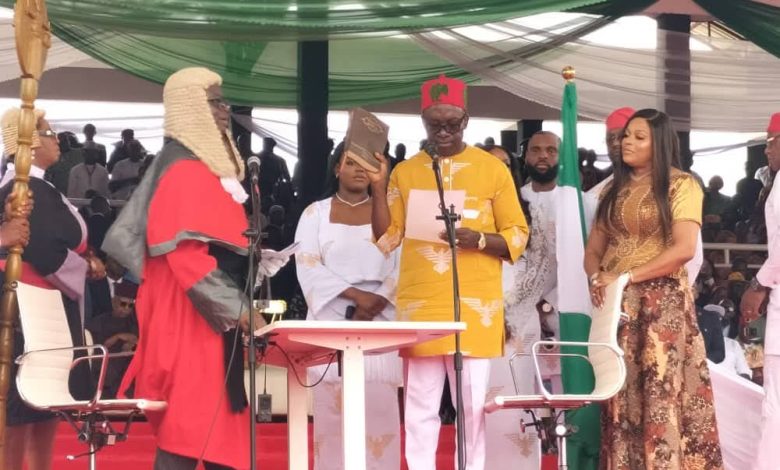
Speaking during his second-term inauguration at the Dr Alex Ekwueme Square in Awka on Monday, Governor Soludo painted a candid picture of the Southeast’s current socio-economic challenges, tracing them to historical setbacks and what he described as “self-inflicted dereliction” following the Nigerian-Biafran war.
“Yet today, the Southeast is performing far below its potential, and this must change for the sake of our future and generations to come,” Soludo said.
“Several years of self-inflicted but devastating war of attrition, together with the complicit silence of the graveyard, threatened to create a desolate homeland, setting the wheel of development several decades back.”
Reflecting on the region’s historical achievements, he recalled that the Eastern region was once considered the fastest-growing sub-region in the world in the early 1960s.
“Nine years after the Nigerian-Biafran war, Igbos occupied the Vice-Presidency and the Speakership of the House of Representatives until 1983. From 1999 to 2007, we held the Senate Presidency. Yet the ordinary Igbo man in towns such as Okpoko, Ngorkpoala, Akwete, Ezzamgbo, or Udenu continues to ask: how did these positions improve our lives?” Governor Soludo warned against overemphasis on symbolic political positions.
He called for a new narrative for Igboland—one of healing, coalition-building, and pragmatic politics. Quoting his 2022 inaugural address, he noted that with millions of Igbos living in other parts of Nigeria and their substantial non-land assets, “we need Nigeria and Nigeria needs us.”
He stressed that agitation for equity must be conducted within the framework of democracy, warning that armed struggle is self-defeating.
“Never again should we turn the gun on ourselves in the name of agitation,” he said. “We must commit to justice and healing—justice for all victims of acts of commission and omission, and healing of the land, with eternal lessons to teach our children.”
On political strategy, Governor Soludo urged Ndigbo to engage in Pan-Nigeria coalitions to secure equitable opportunities for the region.
“One obvious way for us to matter and be taken seriously is the strength of our organization and votes. I pray that Ndigbo will never waste their votes again.”
He also launched a new initiative, inspired by social media conversations, dubbed MAGA—Make AlaIgbo Great Again, aimed at reviving the Southeast’s economic fortunes. Drawing inspiration from post-war leaders such as Dr. Nnamdi Azikiwe, Dr. M.I. Okpara, and Dr. Akanu Ibiam, Soludo called for structured lobbying and a deliberate federal infrastructure agenda to ensure equality in national development.
“With good governance by Southeast governors, combined with the resilience and enterprise of our people, the Southeast will soar once again as an axis of opportunity and prosperity,” he said.
Vice President Kashim Shettima in his address described Soludo as a courageous leader, insisting that he has through his developmental strides shown Anambra people the stuff he is made of.
“Soludo has shown courage and what it means to be a leader. He has worked and there is no doubt that the people of Anambra State have seen what some of us saw in him.
“It is not surprising that his people have voted him against and entrusted him with office. It is not about the brilliance of the man at the top but about his steadiness and courage. This task of leadership is not usually easy. The true burden before us is the reformation of our people.
“From what we have seen, Anambra has every reason to look ahead with hope and happiness,” Shettima said.