By David-Chyddy Eleke
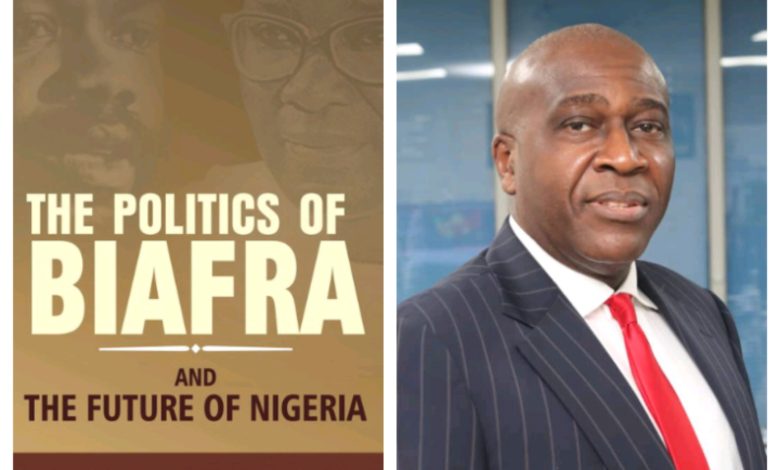
10 years after it was first published, the book, ‘The Politics of Biafra and the Future of Nigeria’, written by ex-lawmaker, erudite lawyer and technocrat, Hon Chudi Offodile continues to stand as a testament of the erudition of his mind.
The book which was first published in 2016 and launched elaborately at the Shehu Musa Yar’Adua Centre in Abuja and later in London in the very presence of great minds in Nigeria has not lost its message about what it truly means to be a leader, and also the recommendations of how to build a working Nigeria.
Being an Igbo man; and with the title “the politics of Biafra”, one would expect the writer to delve into the usual chants of marginalization which was the key issue that led to the 1967-1970 civil war – and has continued to be what those who hold onto secession bandy to till date, but beyond that, Offodile did not only use the book to give account of the 1966 coup, which was tagged an Igbo coup, the war itself, but went further to make very valid proposals about what the leaders of Nigeria can do to put her on the right track as a peaceful and progressive nation, and also permanently put secessionist agitations in check.
Reading through the pages of this book, a reader will not just be going through its pages, but also reading the inner thoughts of the author, seeing through it, a man who loves his people, but not blinded enough to stick with them when they are making decisions out of sentiments, but will rather choose the path that will bring lasting peace for them.
This can be seen in several submissions by the author in the book.
But during a review of the book at Channels Book Club hosted by Kunle Kasumu, Offodile when asked which side he stood between the options of being a supporter of Nnamdi Azikiwe who was a federalist during the whole imbroglio and the side of Chukwuemeka Odumegwu Ojukwu who was a secessionist, Offodile analysed that: “During the period leading to the war, Zik and Ojukwu were on the same side, up till Aburi, ideologically. That was up till some time 1968. It was in late 1968 when Ojukwu made the declaration that Biafra sovereignty was not negotiable that Zik now parted ways with him and went on exile in London.
“If I were in Biafra then, I would not have gone with Zik, I would have gone with Ojukwu. But, as bad as things are today, it is not as bad as bombs dropping on women and children then. So the point is that the engagement process should be different. Today, Zik and Ojukwu would have been on the same side,” he posited.
With this answer he distinguished himself as a man who loves and stands by his people, but is more at home with what would bring peace and solution to the problem of his people. Many other such instances abound in the book.
Reading the thought process of Offodile through the pages of the book, one would see a firm and erudite leader, a fearless one too, but nonetheless willing to sacrifice his own thoughts to achieve peace for his people.
With such a personality as Offodile, one would not be surprised that a man in the stature of Prof. Chukwuma Soludo contributed three appendices to the book. As the saying goes, birds of the same feather flock together. The appendices were derived from previously authored pieces by Soludo.
Being a man with consistent character, Soludo from the early days has stood for the same thing as today. Writing under the title: Reconstructing Nigeria for Prosperity, Soludo quoted his 2005 national democracy day lecture where he argued that: “For sustainable democracy, fundamental changes are required for the constitution, the electoral system, the fiscal federalism, as well as a gamut of legal-institutional reforms that are developmental and capable of promoting private enterprise and competition.”
In another part of the appendix, Soludo quoted Thomas Jefferson who argued that: “Two enemies of the people are criminals and government, so let us tie the second down with a chains of the constitution so that the second will not become the legalized version of the first.”
These pieces were authored at a time when he hadn’t even been entrusted with the leadership of Anambra State, one of the most important states in Igboland.
Today, as governor, Soludo is still living out his belief, and not only thinking the welfare of Ndigbo, but championing a reintegration process that will help Ndigbo navigate the politics of Nigeria, warm its way to the centre stage and also begin to gain the accruing dividends of being a part of the whole.
As Soludo journeys through his second term in office, he needs to not only worry with reintegrating the South East into Nigeria and developing Anambra to the height he has proposed, but also ensure that the bar of governance in the state is not lowered by ensuring that after a successful second term, he picks one with his kind of thinking, understanding and disposition to issues to lead Anambra, which is the head of Igbo land, so that a path can continually be chatted for Ndigbo through Anambra.
Dr Chudi Offodile fits the description. A 1987 law graduate of University of Nigeria Nsukka, author and a former member of the Federal House of Representatives is the Managing Partner of Chudi Offodile & Co, with concentration in Regulatory Compliance, Maritime Law, International Trade and Finance and Oil & Gas Law. His client base includes local and international organizations, including the Nigerian National Petroleum Corporation (NNPC). He was sworn In as a Notary Public in 2010.
Offodile is married with three children and currently Executive Director Finance and Administration at Nigerian Maritime Administration and Safety Agency (NIMASA), which is the apex regulatory body for maritime safety, security, maritime labour, and shipping development in Nigeria. Mm
Eleke is an Anambra based journalist. He can be reached on donbaron2004@gmail.com.