By Kenechukwu Ofomah
The Anambra State Government has called on citizens and other stakeholders to play active role in the state’s 2027 budgetary processes to ensure that public resources address the most pressing development needs of the people.
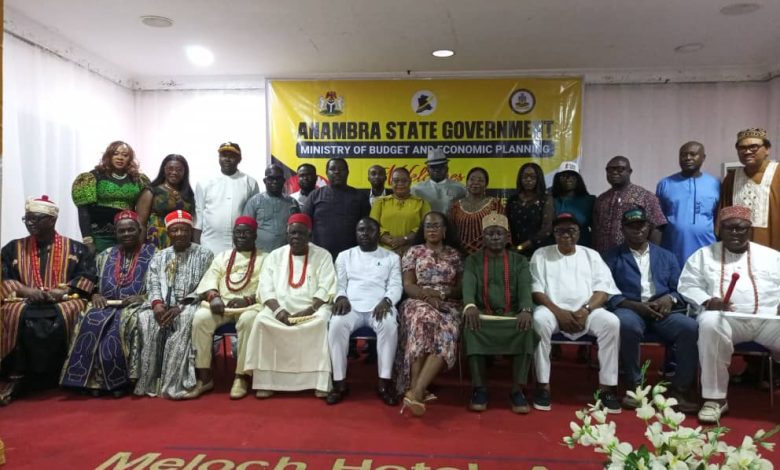
The State Commissioner for Budget and Economic Planning, Hon. Chukwukadibia Okoye, disclosed this during the Anambra State Stakeholders’ Consultative Forum on the 2027 Budget held in Awka on Friday.
The forum attracted stakeholders from the private sector, development partners, relevant ministries, departments and agencies (MDAs), community leaders, civil society organisations, persons with disabilities and other interest groups.
In his welcome remarks, Okoye said the state’s fiscal framework for 2027 would focus on maintaining fiscal discipline, strengthening internally generated revenue, sustaining capital investment and ensuring that public expenditure translates into measurable improvements in the lives of residents.
He explained that the government’s fiscal planning was anchored on the Medium-Term Fiscal Strategy (MTFS), Medium-Term Sector Strategies (MTSS) and the States Action on Business Enabling Reforms (SABER) programme.
According to him, the frameworks would guide resource allocation, promote fiscal sustainability, improve the business environment and ensure that the budgets of ministries, departments and agencies align with the state’s development priorities.
Okoye identified infrastructure expansion and urban regeneration, business and micro, small and medium enterprise (MSME) development, human capital development and social services, as well as grassroots economic inclusion, as major priorities for the 2027 fiscal year.
“The state government is committed to ensuring that community needs identified through the consultation process were reflected in capital expenditure.
“The state budget is more than an administrative document. It represents choices about government priorities and the needs of the people,” he said.
Presenting the Medium-Term Expenditure Framework (MTEF) and fiscal outlook, the commissioner said the state was targeting economic growth of about 4.9 per cent in 2027, rising to 5.2 per cent by 2029, while expenditure was projected to increase from approximately ₦813.7 billion in 2027 to ₦1.3 trillion in 2029.
He added that the government would prioritise internally generated revenue as part of efforts to finance its development agenda without excessive reliance on borrowing.
According to him, the state is not keen on borrowing but would consider it where necessary for developmental purposes, while maintaining debt sustainability and ensuring prudent utilisation of public resources.
Okoye stressed that revenue generation was a collective responsibility, urging residents to meet their tax obligations so they could demand accountability and improved public services from the government.
He also identified persistent inflation and climate-related challenges as potential risks to the fiscal outlook, while expressing expectations of improved oil receipts and more stable economic conditions.
Also speaking, the Secretary to the State Government, Chiamaka Nnake, described the consultative forum as an important avenue for obtaining citizens’ input before the budget preparation process begins.
Nnake acknowledged that some demands submitted during previous consultations might not have been met because of limited financial resources, but maintained that citizens should continue to speak up, particularly on issues affecting their fundamental needs.
“The major objective is to ensure that the budget addresses the needs of ordinary residents and helps close existing development gaps.
“The state’s emphasis on capital expenditure, which accounts for more than 70 per cent of the budget, demonstrates the government’s development-oriented approach.
“I urge you to make constructive contributions that would help produce a budget responsive to the needs and aspirations of the people,” Nnake told the gathering.
Earlier, the Acting Director of Planning in the Ministry of Budget and Economic Planning, Mrs. Edith Nwachukwu, said citizen participation was essential to ensuring that budget allocations reflected the actual needs of communities, particularly poor and vulnerable groups.
She explained that the consultative process provided a platform for citizens, civil society organisations and community groups to influence government priorities through a bottom-up approach to budgeting.
Nwachukwu said the process would promote community ownership, strengthen budget credibility and encourage collaboration between government institutions and citizens.
“This forum should not be treated as a one-off event but as part of a sustained engagement through which community priorities would be identified, incorporated into the budget and monitored during implementation,” she said.
In a presentation on ‘Citizens’ Engagement and Participation in Budgeting’, a Co-Chair of the Open Government Partnership (OGP) in Anambra State, Prince Chris Azor, attributed some of the weaknesses in Nigeria’s budgeting process to insufficient efforts to ensure meaningful public participation.
He maintained that citizen engagement should extend beyond contributing to the preparation of budget documents to include monitoring projects and tracking the implementation of approved allocations.
According to him, Anambra State has recorded significant progress in citizen participation in budgeting, noting that the state joined the Open Government Partnership in 2017 to strengthen transparency, accountability and public engagement in governance.
He urged citizens to demand explanations whenever they were excluded from budgetary processes, stressing that public participation was necessary to ensure that government spending reflected the priorities of the people.
The stakeholders’ forum also provided the opportunity for communities and other interest groups to identify priority projects and make recommendations to guide the preparation of Anambra State’s 2027 budget.