Paul Chukwuma, Tinubu, and the Rally That Shut Awka Down: Remaking the South-East
Political opinion

By Chinedu Anselem Nebeife
There are rallies that fill streets, and there are rallies that change conversations. What happened in Awka yesterday was both.
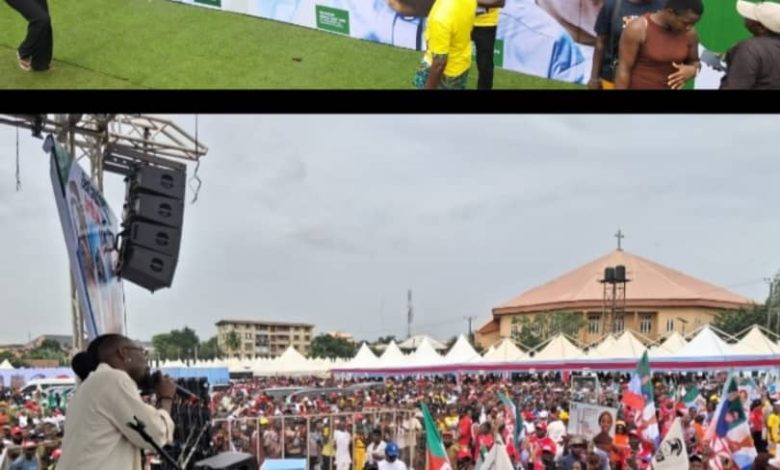
When Chief Paul Chukwuma, Deputy Director-General of the Tinubu Support Group, TSG, South-East Zone, brought the South-East chapter of the TSG together in Awka, the capital city of Anambra, the city did not merely host a political event. It paused. The roads gave way to a sea of supporters, women’s groups, youth networks, and party stakeholders, all moving to one rhythm. Those who say the South-East cannot be mobilised for the Tinubu project have just been handed an answer they cannot wave away.
Political crowds are cheap in Nigeria; anyone with a budget can rent a field. What cannot be rented is conviction, and conviction was the dominant mood in Awka yesterday. The crowd was not a transaction but organic. It was an expression of something the region has been quietly weighing for some time: that standing apart from the centre of power has cost the South-East dearly, and that engagement, not estrangement, is the more intelligent path to recovery.
That is the first lesson of the Awka rally. The South-East is not a bloc that votes by reflex or sulks by habit. Instead, it is a region of traders, builders, professionals and innovators who judge politics by a simple test: does it open doors? Awka showed that when the case for partnership is made by someone with local credibility and organisational discipline, the region listens, and then it turns out in force.
Every national project eventually discovers that the hardest part of politics is not the message but the messenger. A message about inclusion delivered by a stranger sounds like a pitch. Delivered by a son of the soil who understands the region’s grammar of loyalty, grievance and aspiration, it sounds like an invitation.
Chief Chukwuma has understood this from the start. He has not approached the South-East as a territory to be conquered, nor as a vote bank to be harvested every four years. He has approached it instead as a constituency to be respected, with its own history, its own wounds and its own legitimate expectations. His stunning Awka rally did not ask the South-East to forget its grievances. It offered a credible route to resolving them. That is the difference between mobilisation and manipulation, and it is why the Awka turnout carries weight beyond the monumental numbers we witnessed.
He also understood that a rally is only as strong as the architecture behind it. By standing shoulder to shoulder with the APC party structure and her candidates for the Senate and the House of Representatives, he tied the presidential vision to the legislative ground game. Voters were not invited to cheer for a distant figure. They were shown the full team: the President whose re-election they are being asked to support, and the men and women who would anchor the region’s voice in the National Assembly. A President and his legislative caucus are two sides of the same coin, and Awka was the first time many voters saw both faces together.
The Tinubu ecosystem is, at its best, a coalition-builder. Its founding genius lies in the understanding that Nigeria is governed not by decree but by alliance, and that no national victory is durable without broad regional ownership. The South-East is the part of that map where the work is richest and the potential least exhausted. And what is more, Anambra is the right place to begin. It is the region’s commercial and cultural heartbeat, a state whose citizens are found in every corner of the federation, whose enterprise sustains markets from Lagos to Kano, and whose political temperature the rest of the South-East watches closely. A strong and definitive APC showing here is not a local achievement. It is a signal across the region that the door to the Tinubu coalition is open and that those who walk through it will find a seat at the table.
For the President’s strategists, the lesson is practical. The South-East cannot be unlocked from Abuja alone. It needs trusted regional operators, people who can translate national intent into local confidence, convene stakeholders who rarely share a room, and turn goodwill into structure. Chief Chukwuma has demonstrated that capacity beyond every reasonable doubt. Awka is the proof of concept. What remains is to scale it across the five states of the zone and to match organisation with delivery.
It would be dishonest to pretend this is a one-way street. The South-East is not asking for charity, but it is entitled to be candid about what partnership must look like. The region wants infrastructure that connects its commerce to the nation: roads, rail, ports and power. It wants a fair share of appointments and a visible place in the national decision-making architecture. It wants security arrangements that protect its people and its businesses, and a political settlement in which no part of Nigeria feels like a guest in its own country.
These are not demands made against the Tinubu administration. They are the terms on which a lasting partnership is built, and the Awka rally put them on the table in the best possible way: not through protest, but through participation. A region that turns out in its thousands to support a re-election bid has earned the right to speak plainly about what it expects in return, and a President who understands coalition politics will recognise that plain speaking as a form of respect.
Inclusion, properly understood, is also a gain for the centre. A Nigeria in which the South-East feels invested is a more stable, more productive and more confident Nigeria. The President who delivers that outcome will have accomplished something that eluded many of his predecessors: bringing a proud and capable region fully into the national project.
Awka should be read as a beginning. The South-East is in the early stages of a political recalibration, and the old habits of reflexive opposition are being tested against the evidence that engagement yields dividends. Regions are remade not by speeches but by moments in which people realise that a different future is possible. For many who lined the streets of Awka yesterday, that moment arrived.
The task now is to turn spectacle into structure: grassroots networks that outlast the rally, a disciplined ground operation behind the candidates, and a continuing dialogue between the region and the centre in which promises are tracked and delivered. Those who dismiss rallies as noise have never had to build the organisation that makes the noise possible. Chief Paul Chukwuma has, and the result was a city that stood still and was literally shut down.
The lesson for the Tinubu ecosystem is clear. The man who can shut down Awka for a cause is the man who understands how to open the South-East to a larger one. Nigeria’s next chapter will be written by those who can build bridges across old divides, and on that evidence Chief Chukwuma is not merely a participant in the remaking of the South-East. He is one of its architects.
Chinedu Anselem Nebeife is
Director, Media & Strategy
Tinubu Support Group, TSG, South-East Zone