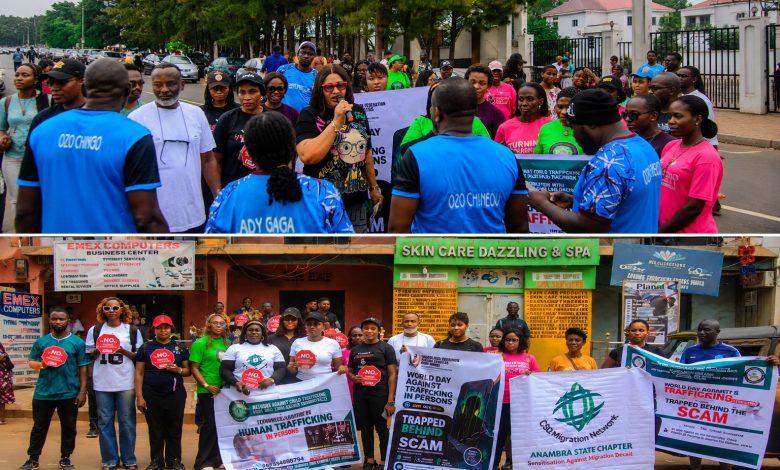
The Anambra State Government in collaboration with the Civil Society Network on Migration and Development (CSONetMaDe), security agencies, government institutions and other stakeholders in State, over the weekend, took the campaign to combat human trafficking in Anambra State to the streets, calling on residents to expose traffickers before more lives are destroyed by false promises of greener pastures.
The awareness campaign, was held in Awka to mark the 2026 World Day Against Trafficking in Persons.
It also witnessed the active participation of officials from the International Federation of Women Lawyers (FIDA), the Nigeria Security and Civil Defence Corps (NSCDC), the Nigeria Immigration Service (NIS), the Network Against Child Trafficking, Abuse and Labour (NACTAL), and the Anambra State Ministry of Women Affairs and Social Welfare, among other stakeholders.
With the theme, “Trapped Behind the Scam,” participants took the sensitisation campaign from the State House of Assembly complex, Awka, to various motorparks and other public places, educating residents on the dangers of human trafficking and the tactics used by traffickers to lure unsuspecting victims.
The State Commissioner for Women and Social Welfare, Mrs Esther Onyekesi, who led the awareness exercise, said despite being receptive to visitors and residents, Anambra State under its present administration has zero tolerance for human trafficking and other related vices.
Onyekesi commended the CSONetMaDe and NACTAL in Anambra for their strategic collaborations that have made human trafficking and irregular migration a topical issue requiring collective action to address, assuring that her Ministry is committed to collaborating with any well-meaning organization with genuine concerns towards addressing the twin social issues.
The Anambra State CSONetMaDe and NACTAL coordinator, Eucharia Onyemaobi, while speaking during the exercise, stressed the need for families to become better informed, describing awareness at the family level as a critical tool in preventing trafficking.
She observed that many fall prey to the antics of traffickers because of ignorance, desperation and deceptive promises of employment and a better life abroad.
“When we talk about human trafficking, we are talking about deceit, exploitation, organ harvesting and other forms of abuse. Families must be informed so they can make the right decisions and protect their loved ones,” she said.
Onyemaobi called on youths not to allow desperation or the glamorous lifestyles portrayed on social media to push them into making dangerous decisions.
“We are appealing to our youths to avoid desperation. Many traffickers exploit people’s desire for quick success. Not everything you see on social media reflects reality,” she said.
She explained that the public sensitisation at motor parks generated encouraging feedback, with many participants asking questions that would help shape future advocacy and policy engagement.
Commending Governor Chukwuma Soludo for signing the Anambra State Human Trafficking Law and the wife of the governor, Dr. Nonye Soludo, for her support for victims, including the recent rescue and rehabilitation of a trafficking survivor, Onyemaobi appealed to the government to intensify efforts against human trafficking, particularly internal trafficking, which she described as an emerging concern.
In her remarks, the Chairperson of the International Federation of Women Lawyers (FIDA), Anambra State Branch, Barr. Amara Muojeke, said traffickers often exploit people’s desire for economic opportunities by offering fake jobs and promises of a better future.
She urged residents to promptly report suspected trafficking cases to FIDA, the Ministry of Women Affairs and Social Welfare, the Nigeria Immigration Service, the NSCDC and other relevant agencies.
According to her, the recent rescue of trafficked victims in Aguleri, Anambra East Council Area of Anambra State, was only possible because someone raised the alarm.
“Those children were rescued because someone spoke up. If you suspect any case of trafficking, do not keep silent. Report it immediately because every victim is someone’s child, sister or brother,” she said.
While acknowledging that economic hardship contributes to trafficking, Muojeke insisted that it should never be used as an excuse, highlighting the Anambra Government’s ‘One Youth, Two Skills’ initiative as one of the empowerment programmes capable of reducing vulnerability among young people.
“There are legitimate opportunities for young people to acquire skills and earn a living. You do not have to risk your life or become involved in criminal activities because of the illusion of quick wealth,” she added.
The Deputy Commandant of the Nigeria Security and Civil Defence Corps (NSCDC) and Head of the Anti-Human Trafficking Unit, Edith Ebere Nwufoh, explained that traffickers operate through what she described as the three Rs namely- Reason, Recruitment and Routes.
She said traffickers are motivated by financial gain, recruit victims through deception and carefully map out routes for moving victims across states and international borders.
Nwufoh appealed to commercial drivers and transport operators to assist security agencies by reporting suspicious movements of children and young persons.
She also highlighted the three Ps of anti-trafficking efforts- Prevention, Prosecution and Partnership, stressing that ending human trafficking requires collective action from parents, teachers, religious leaders, transport operators, security agencies and civil society organisations.
Participants at the campaign urged Nigerians to remain vigilant, report suspicious activities and reject deceptive offers that could lead to exploitation, insisting that sustained public awareness remains one of the most effective weapons against human trafficking.