By Tony Okafor
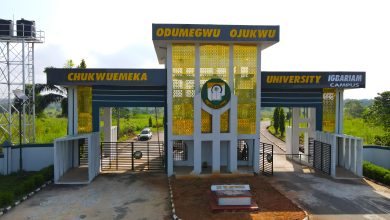
For close to three hours on Thursday, July 2, 2026, journalists were taken on an extensive tour of the Chukwuemeka Odumegwu Ojukwu University (COOU), Igbariam, where ongoing infrastructure development, environmental renewal, academic expansion and growing private-sector support combined to portray an institution pursuing an ambitious transformation agenda under the leadership of its Vice Chancellor, Prof. Kate Omenugha.
The tour, conducted by the University’s Public Relations Officer, Dr. Harrison Madubueze, offered media practitioners a firsthand assessment of projects and facilities spread across the institution, many of which are either under construction or nearing completion.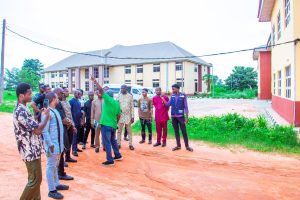
One of the most striking features was the University’s ongoing landscaping initiative, anchored by what the management has christened the Vice Chancellor’s Orchard—a vast collection of economic trees planted across the campus.
Beyond their economic value, the trees are expected to provide shade, improve the campus ecosystem, enhance biodiversity and create a greener learning environment in line with the University’s long-term environmental sustainability programme.
The journalists also observed several buildings under construction and others nearing completion to accommodate new programmes, particularly in the medical sciences, reflecting the University’s determination to broaden its academic offerings and strengthen teaching, learning and research.
Another notable development was the improvement in hostel accommodation, especially for female students. The upgraded facilities are expected to encourage more students to reside on campus, improve security and enhance the overall learning experience.
Beyond physical infrastructure, the Vice Chancellor’s administration appears to be winning the confidence of philanthropists, alumni, development partners and other friends of the University who are increasingly identifying with its vision.
University officials said the renewed confidence has translated into donations, project support and fresh commitments from individuals and organisations willing to invest in the institution’s growth, a development they attribute to transparent leadership and a clearly articulated transformation agenda.
Some of the interventions are already visible across the campus. Barr. Okeke is constructing a modern bakery, while Dozie Mbanefo is developing an artificial lake at no cost to the University. In another major intervention, Ikenga Umuawulu has built and equipped a state-of-the-art Information and Communication Technology (ICT) Centre. The projects underscore the growing confidence of private individuals in the University’s development vision.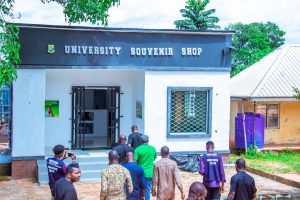
Speaking during an interaction with journalists, Prof. Omenugha said one of the greatest aspirations of her administration was to give COOU greater visibility and recognition among the comity of universities through quality education, improved infrastructure, environmental sustainability, innovation and institutional reforms.
She appealed to media practitioners to partner with the institution in projecting its achievements and strengthening its public image.
According to the Vice Chancellor, the renewed efforts are already yielding positive results, with the University recording increased interest from stakeholders, development partners and prospective students.
She noted that more candidates now select COOU as their institution of first choice during the Joint Admissions and Matriculation Board (JAMB) admission process.
Omenugha reiterated that her administration is driven by the vision of giving the institution viability, positive visibility and value re-engineering, while pursuing the ambitious target of planting about one million trees to make the campus environmentally sustainable and aesthetically attractive.
The University also disclosed that it was discussing with a vehicle manufacturing firm on ways of improving transportation within the campus as part of ongoing efforts to provide a more conducive learning environment.
On recent disciplinary actions taken by the University, the Vice Chancellor disclosed that lecturers and other staff members dismissed by the Governing Council had been granted one month to appeal the decisions against them.
She explained that those affected were sanctioned for various offences, including sexual exploitation of students and ethical misconduct, stressing that due process was followed before the Council arrived at its decisions.
The Vice Chancellor also dismissed claims that the dismissal of Prof. Chike Osegbue was connected with the selection of the University’s Vice Chancellor, insisting that it was based solely on allegations relating to his failure to teach an assigned postgraduate course and his refusal to appear before a disciplinary panel to explain his actions.
She maintained that the ongoing litigation over the matter would not distract her administration from its mandate of repositioning the institution.
Omenugha expressed appreciation to Anambra State Governor, Prof. Chukwuma Soludo, for the infrastructure development taking place at the University’s Uli (Mbadinuju) Campus.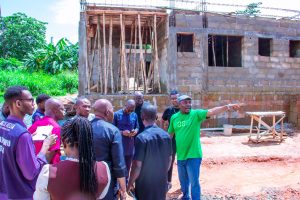
She also appealed to host communities, alumni, corporate organisations and other stakeholders to partner with the University in providing additional hostel accommodation and other critical infrastructure to enhance campus security, student welfare and academic development.
Some students who spoke to one of the journalists commended the efforts of the University management, saying: “It’s now that we can proudly say that we are in a university we are proud of. In fact, the management of the University is doing excellently well.”
As the tour ended, the impression left on many of the visiting journalists was that of a university undergoing deliberate and far-reaching renewal. From expanding infrastructure and greener surroundings to improved student facilities, increasing support from philanthropists and plans to modernise campus transportation, COOU appears to be charting a new course under a Vice Chancellor whose vision extends beyond today’s achievements to building a more competitive, environmentally sustainable and globally attractive institution.