By Tony Okafor
Peter Obi remains arguably Nigeria’s most talked-about politician without an elective office. That visibility comes with a price.
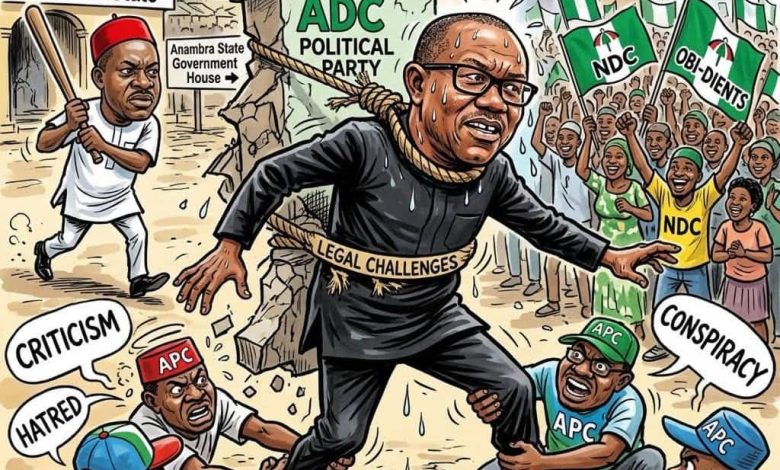
As the 2027 election approaches, a familiar political sickness is already resurfacing: when politicians run short of ideas, they often turn to character assassination.
Nigeria cannot afford another election season in which ethnic suspicion, lazy allegations and outright falsehoods take the place of serious arguments about how to fix a country facing deep and painful challenges.
Obi is not infallible, and every aspect of his public record—from his stewardship of Anambra State to his economic prescriptions and political alliances—is open to questioning.
He should be challenged, and challenged rigorously. But criticism is not a licence to rewrite history or turn unverified claims into established facts.
One of the accusations repeatedly thrown at Obi is that he was hostile to northerners during his time as Anambra governor. Yet some northern residents and community leaders who lived in the state during his administration have publicly offered accounts that contradict this narrative.
Alhaji Gidado Sidikki, chairman of the Northern Community in Anambra, for instance, publicly confirmed receiving a ₦10 million agricultural loan under Obi’s administration. He also said the government absorbed unpaid debts owed by struggling farmers.
Similarly, Alhaji Garba Haruna, the Sarkin Hausawa of Awka, testified that his children benefited from Obi’s free education policy.
Then there is the long-running controversy over the demolition of a mosque in Onitsha, which has become one of the more persistent allegations directed at Obi.
But Alhaji Mahmud Ibrahim, secretary of the local Muslim community in Anambra State both now and during Obi’s tenure as governor, said the destruction occurred during sectarian reprisals in February 2006—weeks before Obi assumed office on March 17, 2006.
That distinction is important. A political argument may be fierce, but it should not require facts to be bent to fit a preferred narrative. Once demonstrably false or misleading claims are repeated often enough, they acquire the dangerous appearance of truth.
This is why politicians should be careful about dragging entire ethnic or religious communities into partisan battles.
Northerners, southerners, Christians and Muslims are not political props. Their experiences are diverse, and no politician should be allowed to appropriate or manufacture their grievances simply to score electoral points.
The responsibility also extends beyond politicians. Institutions charged with protecting the integrity of the electoral process and maintaining public order must take seriously the spread of deliberate disinformation, hate speech and incitement.
Laws should not exist merely as impressive words on paper while the civic space is steadily poisoned by reckless political propaganda.
Nigeria has far more serious problems to confront.
The economy is under severe pressure. Poverty remains widespread. Insecurity continues to haunt communities, while public institutions struggle with declining trust and capacity.
These are the issues that should define the 2027 election.
If Obi’s economic proposals are unrealistic, tear them apart. If his policies lack depth or his political alliances raise legitimate questions, put those questions before him and demand answers.
That is what a healthy democracy requires.
But criticism should come with evidence. Political opponents should not have to manufacture scandals when there are enough genuine issues to debate.
Slander may win a headline or excite a partisan crowd, but it cannot build a nation.
As 2027 draws closer, Nigerians deserve a contest of ideas, records and competence—not a competition in who can tell the most damaging story about an opponent.
The country has suffered enough from politics without conscience.
Let the politicians argue. Let Nigerians scrutinise the candidates. Let the facts speak.
And let truth, rather than calumny, carry the day.