By Tony Okafor
The frightening incidents of electrocution at Aroma Junction in Awka have once again exposed a disaster waiting to happen in the heart of Anambra State. If urgent and decisive action is not taken by the electricity distribution authorities and the government, the next victims may not survive to tell their stories.
Only in January this year, a 10-year-old child was electrocuted in his guardian’s tailoring shop near the filling station leading to Ifite at Aroma after heavy sparks erupted from the high-tension cable.
The boy suffered severe burns and has remained in and out of hospital ever since. Beyond the physical agony, his education and childhood have been brutally disrupted by an avoidable tragedy.
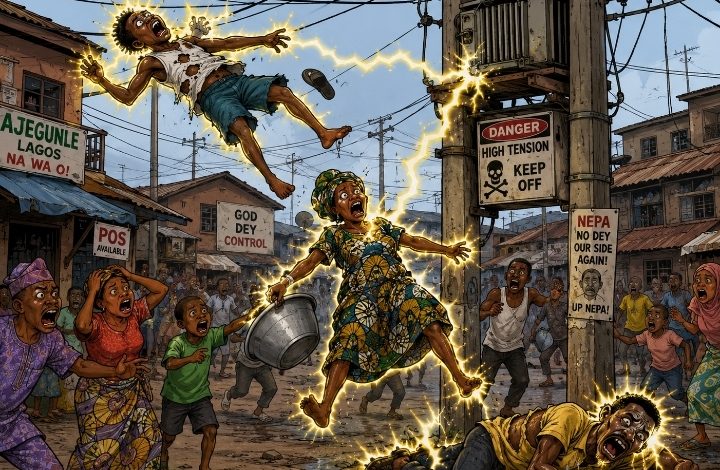
Shockingly, before the memory of that painful incident could fade, another double electrocution occurred on Tuesday this week at the ever-busy Freedom Square, Aroma.
A female Point-of-Sale (POS) operator was electrocuted while carrying out her daily hustle. At about the same time and location, another businessman who had come for his normal activities also fell victim to the deadly sparks from the same high-tension line.
Though both victims survived, they were left with horrifying degrees of burns and trauma that may alter their lives permanently.
The RAZOR Newspaper considers it unacceptable that repeated electrocution incidents linked to the same high-tension installation are occurring in one of the busiest commercial hubs in Awka without a comprehensive emergency response from the relevant authorities.
Even more disturbing is the apparent silence and indifference that have followed these tragedies. None of the victims, to public knowledge, has even received a formal apology or expression of sympathy from the responsible authorities.
Such indifference deepens the pain of victims and their families and creates the dangerous impression that human suffering can simply be ignored.
In saner and more safety-conscious societies, incidents of this nature would immediately trigger official investigations, emergency compensation mechanisms, and institutional accountability.
Relevant authorities or utility providers would ordinarily take responsibility for the hospital bills of victims and, where negligence is established, pay punitive damages accordingly. That is the minimum expected in societies where human life is genuinely valued.
The report that officials of FirstPower Electricity Distribution Company merely visited the area after Tuesday’s incident to carry out palliative repairs is deeply disturbing.
Temporary fixes to a life-threatening problem cannot be the solution. Human lives are too precious to be treated with cosmetic responses and routine technical patchwork.
What exists at Aroma today is no longer an ordinary electricity fault; it is a public safety emergency.
Even more troubling is the persistent and strong allegation that the high-tension electrification line currently causing this havoc—stretching from Ifite, Awka to a former governor’s village—may have been influenced by considerations of personal convenience and political interest.
If indeed such a dangerous installation was approved without adequate long-term safety considerations for densely populated commercial areas, then it represents a grave example of leadership failing the people it was meant to protect.
No matter the status, power, or influence of any public official, no project should place thousands of innocent citizens at daily risk simply to satisfy personal or political interests.
Aroma is one of the busiest locations in Awka. Every day, traders, transport operators, students, POS agents, artisans, and residents troop into the area to earn their livelihoods.
The Freedom Square axis has become a major economic nerve centre. Leaving dangerous high-tension cables hanging over such a crowded environment is equivalent to suspending death over the heads of innocent citizens.
FirstPower Electricity Distribution Company must therefore act immediately and decisively. The company should conduct a comprehensive technical review of the entire high-tension infrastructure around Aroma and adjoining areas.
If the lines must be relocated, elevated, reinforced, insulated, or completely redesigned, so be it. Public safety must take precedence over cost-saving measures and bureaucratic delays.
Governor Chukwuma Charles Soludo must also rise to the occasion. The Anambra State Government cannot afford to wait until fatalities occur before invoking the full weight of government authority.
Relevant ministries, safety agencies, urban planning authorities, and emergency management bodies should immediately audit the area and enforce strict compliance measures.
Furthermore, approvals for any form of trading, construction, or commercial activity directly beneath or dangerously close to the high-tension wires should be suspended pending a proper safety evaluation. Prevention remains cheaper than mourning.
Authorities must act now — before Aroma’s high-tension cables become instruments of mass tragedy.